Thursday, July 22, 2010

Beorn the Proud

Beorn the Proud, Madeleine Polland
(1961; reprinted, Bethlehem Books, 1999), pb., 185 pp.
Ages7-12

This is a story of Viking raids, Ireland and Denmark in the 9th century with an adventure centering around a boy and girl. We really like good historical fiction and have enjoyed many books from this publisher so we were excited to get back to this book which we ran out of time for the last time we went through this time period. However, this book was a disappointment.

On the positive side, the book has an explicit Christian message. The girl in the story, Ness, is an Irish Christian and she advocates the faith to her Viking captors, including Beorn, the son of the chief. The contrast of a God of love versus a god of war and slaughter is discussed, as well as the value of humility rather than arrogance. This is good. However, the Christianity discussed is fairly vague.

Negatively, the story is just not told well. At a couple of places the telling is so vague as to cause confusion for several pages before ideas were explained. There was some adventure and intrigue but it was not compellingly delivered.

So, this book is tolerable but there are plenty of others which provide a more realistic portrait of the era in a more engaging manner.

Labels: ,

Tuesday, January 09, 2007

Before Columbus: The Leif Eriksson Expedition


Before Columbus: The Leif Eriksson Expedition, Elizabeth Cody Kimmel
Landmark Books, (Random House, 2003), pb., 98 pp.

I remember enjoying Landmark books when I was a kid, so I anticipated reading some to my boys. This one is a good tool for telling the basic story of the Viking discovery of the New World. It is not a riveting retelling, but it covers the basics well. An author’s note tells you clearly what was based on data from the old sagas and what was invented by the author to fill in the blanks. That helps a lot.

One intriguing thing is that according to the author, she did not have data about Leif and Erik’s response to the introduction of Christianity by King Olaf. Without concrete data, she tells the story with Leif and Erik rejecting Christianity and holding to the old Norse gods. I wonder why she chose to present the story that way. Since we have already dealt with the Greek and Norse gods and how even in their own descriptions they are inferior to the One true God of the Bible, this was no big deal for us. However, if you have not crossed this bridge yet, then you would need to be prepared for it.

In summary, this book is useful for the history, but is not nearly as enticing as many others we have read. It is short, though, so if your children are accustomed to listening you can work through it.

Labels: , ,

Tuesday, February 28, 2006

The Dragon and the Raven, by G. A. Henty


The Dragon and the Raven, by G. A. Henty
(London: Blackie & Son, 1885; reprint, Preston/Speed Publications, 1995)
Hb., 238 pp.

This is the first Henty novel I have read to my boys. If you are not familiar with Mr. Henty and his novels I would recommend you check out these sites for more information (about Henty 1, about Henty 2, reviews of his books). This sort of information is what prompted me about 7 years ago to begin collecting Henty novels for my boys to read one day. Henty’s books have a great reputation for historical accuracy and for upholding the values of courage, nobility, perseverance, and the like.

This specific book is set in the days of King Alfred of England in the late 800’s. In this time England was regularly invaded by Danish hosts. Alfred is the one who finally defeated the Danes and brought peace to England. In this story Henty creates for us a young Earl named Edmund who fights under Alfred and meets many adventures, in the typical Henty fashion. In the story Edmund is the one who introduces to England advances in warfare particularly naval warfare. In a way he seems to be a precursor to the famed British domination of the seas. Edmund fights the Danes, around England, ends up at the siege of Paris helping to defeat the Danes there and eventually finds adventures in the Mediterranean.

Henty’s concern for teaching history is evident in his preface where he writes:

“Living in the present days of peace and tranquility it is difficult to picture the life of our ancestors in the days of King Alfred, when the whole country was for years overrun by hordes of pagan barbarians, who slaughtered, plundered, and destroyed at will. . . From this terrible state of subjection and suffering the Saxons were rescued by the prudence, the patience, the valour and wisdom of King Alfred. In all subsequent ages England has produced no single man who united in himself so many great qualities as did this first of great Englishmen. He was learned, wise, brave, prudent, and pious; devoted to his people, clement to his conquered enemies. He was as great in peace as in war; and yet few English boys know more than a faint outline of the events of Alfred’s reign—events which have exercised an influence upon the whole future of the English people.”


In another regular Henty feature, the faith of Edmund, though not always at the forefront, does play an important part. The difference between the pagan Danes and the Christian Saxons is significant. It is seen even in how and why they fight. In an important scene, Edmund, the main character, answers a question from Freda a Danish maid.
“How is it that you, whose religion is as you say a peaceful one, can yet have performed so many deeds of valour and bloodshed?”
“I am fighting for my home, my country, and my religion,” Edmund said. “Christianity does not forbid men to defend themselves; for did it do so, a band of pagans might ravage all the Christian countries in the world. I fight not because I love it. I hate bloodshed, and would rather die than plunder and slay peaceful and unoffending people. You have been in England and have seen the misery which war has caused there. Such misery assuredly I would inflict on none. I fight only to defend myself and my country men and women. Did your people leave our land I would gladly never draw sword again” (p.116)

This makes this a valuable lesson for young boys in understanding how fighting fits in a Christian worldview.

Overall, this book started very slowly. Eventually it got going with battles and adventures. In the end my boys were enjoying it, but they admitted early on it was less enjoyable. Even as the action increased, I did think it was not as good a story overall as the first Henty novel I read myself, The Reign of Terror. The language from over a hundred years ago is different in various ways so I found myself regularly editing and paraphrasing. With an audience slightly older this would become less important. I would recommend this book, but know that your crowd will need to have mastered the ability to endure with a book for a while- a very useful ability to acquire!

Labels: ,

Thursday, February 23, 2006

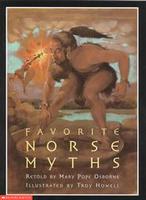
Favorite Norse Myths


Favorite Norse Myths, retold by Mary Pope Osborne
Illustrated by Troy Howell, pb. 87 pp.

We really enjoyed this book! I read all of it and so far have only read some of it to my boys. It is a good source when studying the Viking era (as we have been). Some Christian parents are uncertain about discussing mythology (Greek, Norse or otherwise) with their children. I have discussed this earlier in a post, but I will say again that I do think it is important to ground your children well in the biblical story before dealing with the myths. It was fun to read the Norse creation story to my boys and hear them critique it! It was really funny in points as well. My boys found it ridiculous to think of things happening so much by chance and to hear of the pettiness of these gods.

I found it intriguing to note a number of similarities to the biblical story. I know some feel challenged by such similarities. However, if we all come from Adam and Eve, and then Noah, it is not surprising at all to find remnants of the truth in the stories of various people.

Lastly, the illustrations are really well done. There are reproductions of Viking art illustrating the stories, and there full and double page paintings. Both are really nice.

Labels:

Friday, January 06, 2006

The Story of Rolf and the Viking Bow, Allen French


The Story of Rolf and the Viking Bow(originally published early 1900’s; Bethlehem Books, 1993), 244 pages.

This was a great story! It did seem to start slowly, and the language is different (they talk in Elizabethan English and various Icelandic or Norse terms). However, there is a glossary to help in getting started, and the story is well worth the work. There is grand adventure, battles, intrigue and an underlying theme, as typical in the old tales, of honor, nobility, courage and faithfulness. The closing even drew together points from the story to make a strong point concerning endurance without complaint and the value of humility and being willing to ask forgiveness. French, according to the introduction, was steeped in the ancient sagas and lore, and this shows in the style and quality of his writing. This was another story that made it difficult on the next book we turned to.

The story follows the life of Rolf a young boy in Iceland around 1010 AD, about a generation after Christianity was introduced to the island. In addition to the positive qualities just mentioned, the story is helpful in becoming familiar with this era in history in Northern Europe which has significant connections to the development on British and therefore American history.

This is one of the really good ones. My 9, 8 and 6 year old boys loved it. It is probably too complicated for children younger than 6.

Labels: ,

Here.