Wednesday, February 23, 2011

Encouraging Boys to Manhood

We really enjoy using Veritas Press’ Omnibus curriculum in our homeschooling of our older boys. Good books are suggested (though we don’t read every book listed) and the accompanying study guides with questions are very helpful. My boys are currently reading G. A. Henty’s Winning His Spurs - A Tale of the Crusades, and I especially appreciated the opening paragraph of the study guide which is pasted in below:

Jonathan Edwards entered Yale College at age thirteen and graduated at age seventeen.  He served as a minister at age nineteen, and after returning to Yale at age twenty he passed the examination for a Master of Arts degree.  In an age characterized by a lowering of expectations and standards, we marvel at such maturity and responsibility.  There was a time, however, when a boy was expected to behave like a man at age thirteen.  There was a time when a thirteen-year-old boy was expected to be skilled at something other than playing video games.  Unfortunately, we live in an age characterized by low expectations for our youth.  We rarely envision our teenage boys taking on such responsibilities or taking up five small stones and slaying a giant.
            Winning His Spurs takes us back to a time when a young boy was challenged to behave like a man.  We are encouraged to rethink the expectations we have of our youth.  As we observe the life of Cuthbert, the main character, we get a glimpse of the bravery and courage that a young boy can have.  As we enter into the events surrounding the crusade to recapture the Holy Land, we see the action through the eyes of a valiant boy, and we are forced to reexamine our own lives.  If we view literature and history as an opportunity to explore our own hearts, Winning His Spurs is a call for men to stand up and face life’s challenges with renewed vigor and courage.

Labels: , ,

Wednesday, January 02, 2008

In the Reign of Terror

In the Reign of Terror, G. A. Henty
(Blackie and Sons, no date), hb., 352 pp.
Ages 7+

This is the first Henty book I ever read myself, and it shaped my positive view of Henty. I have looked forward to being able to read it to my boys, and I was gratified to see they enjoyed it as much as I did when I first read it several years ago. I have commented on some other Henty books here previously and often found myself a bit disappointed, largely because those books failed to live up to this one. In the Reign of Terror is the best Henty book I have read. Unlike With Wolfe in Canada the story flowed well and remained human throughout. It was adventurous and engaging. My boys (ages 11, 9, 7) loved it.

This book provides a good picture of life in the midst of the French Revolution. I wanted my boys to see how this movement differs from the American Revolution- the animosity towards upper class, the revolt against God and enthroning of reason and how that led to unspeakable atrocities in the name of liberty. This book does a good job of that. In that vein it is pretty weighty as the family in the story deals with the execution of most of its members. The violence is not gratuitous but the book is honest.

Harry, the English boy who is the main character, provides a great example of humility, grit, bravery, loyalty, chivalry and perseverance. A French Marquis asked Harry’s father to send over one of his sons to show the Frenchman’s son the hardiness of English boys. There is a great story of Harry rescuing the girls of the family from a wild dog and of Harry and one of the sons on a wolf hunt. Eventually as the revolution continues the characters move to Paris and with the death of the Marquis and his wife, Harry takes on the task of protecting the daughters and leading them to safety in England. The story is told in a very compelling way.

There are many great lessons in the book. There is a good example here not only of masculine bravery but also of feminine bravery and the important support a man draws from a woman who believes in him. This last point is subtle and provided some good foundational conversations with my boys about the importance of a good wife. Choosing a wife is a topic that is far from their minds at the moment, but this story provided an opportunity to plant a few important seeds.

We heartily commend this book.
NOTE: Link at the top is to a more recent reprint edition.

Labels: ,

Monday, October 22, 2007

With Wolfe in Canada

With Wolfe in Canada, Or the Winning of a Continent, G. A. Henty
(Blackie and Son, 1886; Preston/Speed Publications, 1999)
Hb., 353 pp.
Ages 11+

I am a Henty fan having enjoyed a number of his books (I have commented on our experience of reading one previously). However, this one was disappointing on several levels. The story meanders seeming as if he wanted to include too many different things. Several chapters do not really discuss the main character but pause to tell the history. Of course part of what I want is the history but detaching the history from the character makes the history more detached. These portions then read more as compilations of data rather than an engaging retelling of the historical story. With so many unusual names of people and places it is hard to follow. It was hard for me to follow so I was pleased with my boys’ perseverance just to hang in there. The fact that there are good adventure moments helped. Such moments are just too few. The book could probably be helpfully abridged.

The title is a bit misleading also since Wolfe only shows up at the end. The main character spends more time in America and Britain than in Canada. He does drop in at key historical events so he is with George Washington during Braddock’s disastrous defeat as well as being involved in various other battles of the French and Indian War.

There are good morals found in the story particularly courage, honesty, and mercy towards those who wrong us. One of the best episodes is early on when the main character James defends a young girl by trouncing a bully who knocked the girl down. My boys still talk about that scene. So the book is helpful in this way, but there are other books that do this as well with stories that are more compelling. I could not help comparing this book with Douglas Bond’s Crown and Covenant Series. Bond is far superior not only in quality of story but even more so in showing the faith as an integral part of the life of the characters.

So, we would not really recommend this book. It is not as good as many other Henty novels. Older readers can appreciate it and learn much history along the way.

Labels: , ,

Thursday, March 02, 2006

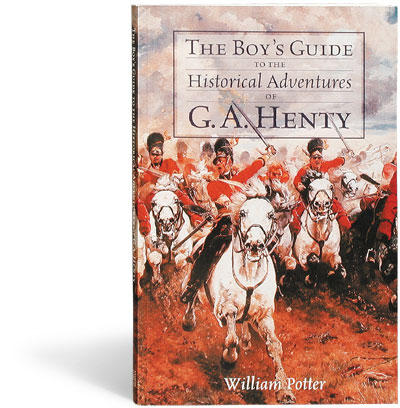
The Boy’s Guide to the Historical Adventures of G. A. Henty


The Boy’s Guide to the Historical Adventures of G. A. Henty
By William Porter (Vision Forum, 2000), pb., 122 pp.

Since I just commented on one of Mr. Henty’s famous novels I thought it might be useful to mention this volume. The book is divided into two parts. The first part is entitled, “Why Boys Should Read the Magnificent Adventures of G. A. Henty,” and contains and introduction to the man and his work. Some might object to the exclusive focus on boys here, but there is no reason to do so. It is valuable to have books that address each gender specifically. Henty’s primary audience was boys as he sought to encourage and teach the values of courage, nobility and heroism- ideas which are not so highly prized to day but are all the more sorely missed. Furthermore, Henty pursues this task from a Christian worldview which is readily apparent in his books. The book contains this excerpt from an interview with Mr. Henty:

To be a true hero you must be a true Christian. To sum up, then, heroism is largely based upon two qualities- truthfulness and unselfishness, a readiness to put one’s own pleasure aside for that of others, to be courteous to all, kind to those younger than yourself, helpful to your parents, even if that helpfulness demands some slight sacrifice of your own pleasure. You must remember that these two qualities are true signs of Christian heroism. If one is to be a true Christian, one must be a Christian hero. True heroism is inseparable from true Christianity, and as a step towards the former I would urge most strongly and urgently the practice of the latter.
It is because this vision so much mirrors my own that I have collected Henty books for my boys. One other quote from the book (this time from Porter) will also help to make the point:

Perhaps the best reason boys should read G. A. Henty has already been alluded to: the Christian character of Henty’s boy-heroes made them men of Honor, fortitude, and perseverance. They took their place as leaders in the army, in civil government, in their professions, in trade, and in their families. They became manly men, unwavering in principle, eager to defend their families and prepared to die for family, nation, comrades, or in a just cause. Many of the real historical characters that anchor the stories, though flawed as all men are, still set examples that did not disappoint the boys of the story. From Richard the Lionhearted to William Wallace, from King Alfred to Gustavus Adolphus, from ‘Chinese’ Gordon to the Duke of Wellington, we see examples of men devoted to duty, unafraid of death, makers of history. Are these not traits we want our boys to admire and embrace?
The second, and longer, part lists 72 of Henty’s historical adventures chronologically and grouped according to historical eras. They span from 1250 B.C. to 1900 A.D. A page is given to each story describing the basic gist of the story. This provides a great tool for using these books in teaching your own children history. Whatever period you are studying, this volume can show you which Henty books are set in that period. Porter claims to have listed all of Henty’s historical novels written specifically for boys. I think I have found some not listed here, but I may be mistaken. At any rate, this book is a very useful tool both for arranging these novels historically and for providing an introduction to this man’s life.

Labels:

Tuesday, February 28, 2006

The Dragon and the Raven, by G. A. Henty


The Dragon and the Raven, by G. A. Henty
(London: Blackie & Son, 1885; reprint, Preston/Speed Publications, 1995)
Hb., 238 pp.

This is the first Henty novel I have read to my boys. If you are not familiar with Mr. Henty and his novels I would recommend you check out these sites for more information (about Henty 1, about Henty 2, reviews of his books). This sort of information is what prompted me about 7 years ago to begin collecting Henty novels for my boys to read one day. Henty’s books have a great reputation for historical accuracy and for upholding the values of courage, nobility, perseverance, and the like.

This specific book is set in the days of King Alfred of England in the late 800’s. In this time England was regularly invaded by Danish hosts. Alfred is the one who finally defeated the Danes and brought peace to England. In this story Henty creates for us a young Earl named Edmund who fights under Alfred and meets many adventures, in the typical Henty fashion. In the story Edmund is the one who introduces to England advances in warfare particularly naval warfare. In a way he seems to be a precursor to the famed British domination of the seas. Edmund fights the Danes, around England, ends up at the siege of Paris helping to defeat the Danes there and eventually finds adventures in the Mediterranean.

Henty’s concern for teaching history is evident in his preface where he writes:

“Living in the present days of peace and tranquility it is difficult to picture the life of our ancestors in the days of King Alfred, when the whole country was for years overrun by hordes of pagan barbarians, who slaughtered, plundered, and destroyed at will. . . From this terrible state of subjection and suffering the Saxons were rescued by the prudence, the patience, the valour and wisdom of King Alfred. In all subsequent ages England has produced no single man who united in himself so many great qualities as did this first of great Englishmen. He was learned, wise, brave, prudent, and pious; devoted to his people, clement to his conquered enemies. He was as great in peace as in war; and yet few English boys know more than a faint outline of the events of Alfred’s reign—events which have exercised an influence upon the whole future of the English people.”


In another regular Henty feature, the faith of Edmund, though not always at the forefront, does play an important part. The difference between the pagan Danes and the Christian Saxons is significant. It is seen even in how and why they fight. In an important scene, Edmund, the main character, answers a question from Freda a Danish maid.
“How is it that you, whose religion is as you say a peaceful one, can yet have performed so many deeds of valour and bloodshed?”
“I am fighting for my home, my country, and my religion,” Edmund said. “Christianity does not forbid men to defend themselves; for did it do so, a band of pagans might ravage all the Christian countries in the world. I fight not because I love it. I hate bloodshed, and would rather die than plunder and slay peaceful and unoffending people. You have been in England and have seen the misery which war has caused there. Such misery assuredly I would inflict on none. I fight only to defend myself and my country men and women. Did your people leave our land I would gladly never draw sword again” (p.116)

This makes this a valuable lesson for young boys in understanding how fighting fits in a Christian worldview.

Overall, this book started very slowly. Eventually it got going with battles and adventures. In the end my boys were enjoying it, but they admitted early on it was less enjoyable. Even as the action increased, I did think it was not as good a story overall as the first Henty novel I read myself, The Reign of Terror. The language from over a hundred years ago is different in various ways so I found myself regularly editing and paraphrasing. With an audience slightly older this would become less important. I would recommend this book, but know that your crowd will need to have mastered the ability to endure with a book for a while- a very useful ability to acquire!

Labels: ,

Here.