Resources for Reformation Day
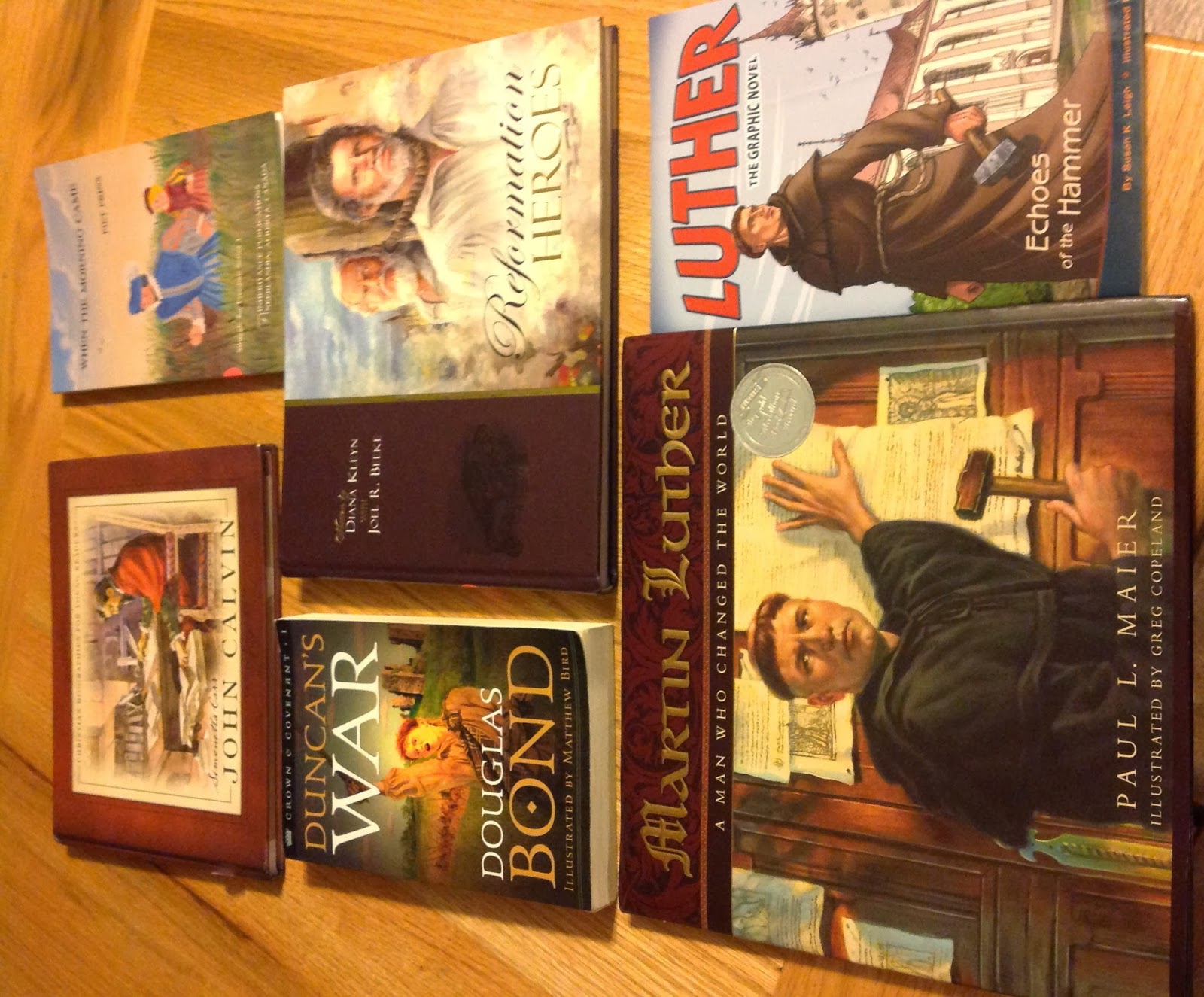
(Sorry, the photo for some reason will not stay vertical!)
Labels: Calvin, Douglas Bond, Martin Luther, reformation, Reformation Day, Struggle for Freedom Series
Comments and recommendations for books for reading to children, particularly books on the bible, history and good fiction
Labels: Calvin, Douglas Bond, Martin Luther, reformation, Reformation Day, Struggle for Freedom Series
Today we have a guest post from Simonetta Carr, whose books I have commended here previously. She has just recently published a new biography of a woman who lived in Reformation Italy. I am thankful to Simonetta for providing us with an explanation of her new book.When P&R asked me if I wanted to contribute to their Chosen Daughters series I had mixed feelings about it. I liked the challenge of writing fiction, especially since English is not my first language, but after focusing very carefully on historical accuracy in my children’s biographies, the idea of imagining scenes and settings seemed frightening. How could I know, for example, the personality of Olympia’s mother? What if my description was very different from reality?
On the other hand, I had the perfect subject for this story. The P&R series is about young Christian women of our past, and Olympia Morata had led a very adventurous life from the time she was twelve. Besides, she was from Italy, my native country, and everyone knows that it’s easier to write about familiar things. I was also excited at the opportunity I would have to familiarize my readers with some events of the Italian Reformation, a period which is still unknown to many.
In some ways, we can say that the Reformation had its roots in Italy, where it was both an expression of dissatisfaction with the obvious excesses of the Roman Catholic Church, and a return to the sources, including a rediscovery of the original Scriptures and the doctrines of the church fathers.
In Naples, a circle of spirituali, mostly inspired by Juan de Valdes, was already spreading pre-reformation teachings in the 15th century. By the time Luther posted his theses in 1517, some like-minded groups had formed in various Italian cities. Slowly, Lutheranism and Calvinism spread throughout the country, silently, as the Church of Rome became increasingly alarmed.
It was in 1542, after a failed attempt to reconcile Protestants and Catholics at the Diet of Regensburg, that Pope Paul III re-established a form of inquisition in the country. At that point, Italian Protestants were left with three choices: keep their faith private, leave the country, or declare their faith and face imprisonment and death.
It was around that time that Olympia Morata shone as a child prodigy, giving signs of her future as the most prolific woman writer of the Reformation. Her life was short and intense, shaken not only by the tumultuous events of the time, but also by personal disappointments, rejection, poverty, illness, and exile.
It was a story I could not pass by, one of those stories which, as we often say, “begged to be told.” Overcoming my hesitations about writing fiction, I began reading and re-reading Olympia’s letters and poems in an attempt to understand and to convey who she really was.
There are many themes in Olympia’s life which will certainly resonate with young people today. Some may identify with her apprehensions leaving home, with her desire to please her father and teachers, or with her nervousness before giving a public speech. Some may recognize themselves in her admission of being normally afraid “of dangers worse than reality” or in her passion to see favorite books translated into her native language. And which of us can’t remember times when a fascination or concern occupied our minds, leaving little room for God?
Someone said that writing a book should change the author. I think Olympia did this for me, as I shared her excitement, passion, and concerns. Through her letters, I watched her growing from an over-achieving and worrisome young girl, obsessed with her goals and hungry for praise, to a mature and heavenly-minded Christian, fully conscious of the deep reservoirs of God’s strength which are available to his children in this pilgrim life.
On my blog (www.simonettacarr.com), I am planning to explain, chapter by chapter, what details were imagined and what are pure facts. All the letters and poems quoted have been carefully translated from the originals. I encourage my readers to pay attention to Olympia’s voice. Maybe, when you finally close the book, you will miss her as much as I do.
Labels: biography, reformation
Labels: reformation, Reformation Day

Labels: Martin Luther, reformation, Reformation Day
Labels: reformation
William Boekestein, author of the book Faithfulness under fire which I commended in the previous post, shared in the comments section the link for a video on the book, and i thought it was so nicely done it ought to be posted here for everyone to see. Thanks for passing this along, Bill, and for taking time to write this book for kids.
Labels: reformation
Faithfulness Under Fire: The Story of Guido de Bres, by William BoekesteinLabels: reformation

Peter Waldo
John Wycliffe
Anne of Bohemia
John Huss
Martin Luther
Philip Melanchthon
The Protest at Speyer
Martin Bucer
Ulrich Zwingli
Heinrich Bullinger
William Tyndale
Edward VI
Thomas Cranmer
Hugh Latimer
Nicholas Ridley
John Foxe
John Knox
Guido de Brès
The Heidelberg Catechism
Caspar Olevianus
Zacharias Ursinus
Frederick III
Peter Martyr Vermigli
John Calvin
Theodore Beza
Jan Laski
The Duke of Alva
William, Prince of Orange
Petrus Dathenus
Quenn Marguerite of Navarre
Queen Jeanne d’Albret of Navarre
Admiral Coligny & the tragedy of St. Bartholomew’s Day
Charlotte, the Nun of Jouarre
William Perkins
William Ames
William Teelnick
Konrad Grebel
Felix Manz
Ludwig Hätzer
Gerog Blaurock
Thomas Müntzer
Jan Mattjis
Jan Beukelssen
Melchior Hoffman
Jakob Hutter
Balthasar Hubmaier
Menno Simons
The Counter Reformation
Labels: reformation, Reformation Day

Labels: reformation
Over at my pastoral ministry blog [which has now moved to a new site] I have commented on a forthcoming historical novel on the life of John Calvin. I commented on it there because this book is intended for adults, but I mention it here since readers will know how much my family has enjoyed Bond’s books. You can see my comments on this book at the other blog.
Labels: Douglas Bond, reformation

Labels: Coulmbus, exploration, history, reformation